Batman 1940's Rookie Card
When it comes to Batman Menko, this is the one I believe to be the earliest. There are many aspects to this Batman Menko that places it in the 1940’s. I will go over each of these aspects in detail. One of which is the amazing story connected to what is printed on the back. Your about to read the story of how History itself will help us date the earliest known Batman Menko card that exists! So, let’s get started.
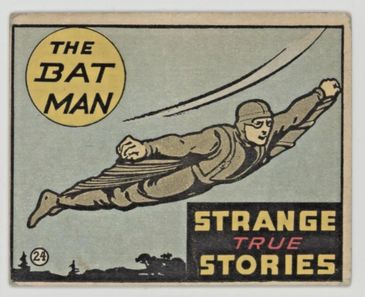
I’ll start from the very beginning. In 1936 the Wolverine Bubble Gum Co released a card in their "Strange True Stories" series called The Bat Man (pic below). Its a man that flies/glides around in the sky and lands with a parachute. He has a grey suit with webbed wings attached to his arms while wearing a pair of goggles. It certainly doesn’t look like the Batman that most of us know. Even though this card exists, the industry has deemed Batman’s rookie card as the 1966 Topps….until now!
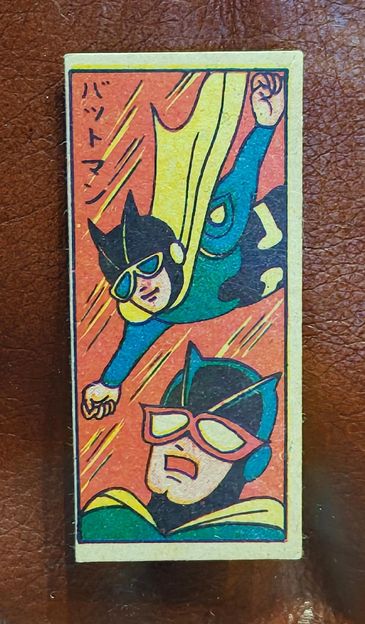
When I first found this Menko, I was intrigued on how Batman looks in the image. I know for sure it is Batman because the Japanese on the front in the upper left corner translates “Batman" (pic below). Without this translation, one could only speculate who is in the image. Once again, the Batman in this image looks different than the traditional Batman. Now that we know for sure its Batman, you can begin to see it in the image. You can see a reference to the older 1936 Wolverine card because Batman is wearing goggles here again. But now Batman has bat ears & a cape. We have to remember that during the 1940-50’s the Japanese didn’t have official rights or permission from DC to print Batman. This is why Batman on Menko from this era looks different. He may have goggles, but most don’t. His pre-1966 chest logo will vary or be absent completely. His suit will look different. The colors of his suit will vary. He may or may not have gloves. The Japanese believed by doing this it looked like they weren’t copying Batman. By making him look different they would have less risk of possible infringement. Another major factor that attributes this Menko to the 1940’s is what we see when we look at this Menko under magnification.
Under magnification, all of the characteristics definitely point to the 1940’s. The entire Menko has solid ink with no dot matrix. This is exactly what we would expect to see on Block Printed Menko from the 1930’s & 1940’s. There is one important fact to mention here. Under magnification, the skin color on Batman’s face & hands has what may appear as dot matrix to the untrained eye. The small dots in the skin color is called Half-Toning. In the 1940’s, block prints used a Benday screen or Halftone process to create gradients. This was a grid of tiny ink dots created by photoengraving, not digital dot matrixes. Also under magnification, you can see the fiberous edges & card surface. The card stock used for Menko in 1940’s is quite distinguishable from the card stock used later in the 1950’s. The 1940's Block Printed Menko have a soft, velvety feel when touched. Another clue is the ink bleed-through that can be seen on the back of the card. This is typical of Block Printed Menko from the 1940's.
The new technology of Offset Lithography printing starting around 1950 & changed how Menko was printed. The colors were more vibrant. The image overall looked better & to beat all, it was cheaper than Block Printing costs. The Nippon Professional Baseball (NPB) was established in 1950. Children's pop culture exploded with new comic heroes, manga & baseball stars. Offset printing allowed printers to cheaply & quickly pump out vast arrays of these colorful Menko. So once 1950 hit, Japanese manufacturers began to modernized their facilities introducing photo-offset lithography. Just to be clear. Offset Lithography already existed. It was invented around 1904 & would later be perfected. It would be better to say, In 1950, Japan's printing industry began a broad transition away from traditional letterpress Block style printing towards the new perfected Offset Lithography printing methods. This offset printing process allowed for sharper, realistic detail, mass production capabilities & standardized multi-color imagery. It only makes sense that Menko makers switched to the new style of printing. Especially when your image looked better & cost less to print. This is important information as it allows us to distinguish Menko in the 1940's from Menko in the 1950's. Under magnification, the ink just lays on the surface of the Menko printed in the 1950’s. Under magnification the ink on a Block printed Menko from the 1940’s has soaked into the paper rather than just laying on the surface. This is why you sometimes see a color on the front that has bled through onto the back. This is an unmistakable clue of a Block printed Menko. This is exactly what we see on this Batman Menko. The closer we look, this Batman Menko is looking more & more like it’s from the 1940’s. But there is still one major clue this Menko is hiding… & its on the back!
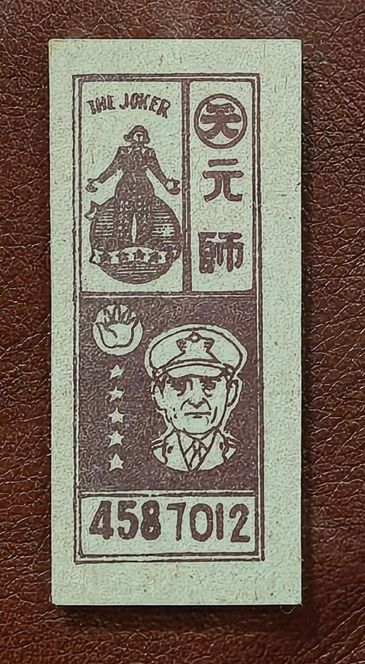
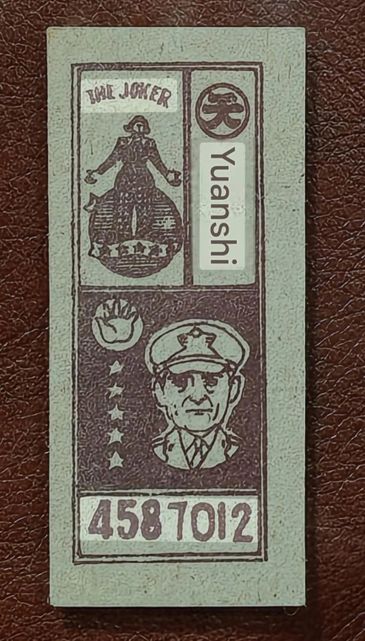
The back of this Menko tells an amazing story that can actually be found in our History books. So, let’s start with the History. At the end of World War II, the US took occupancy of Japan in September of 1945. Five Star General Douglas MacArthur immediately took command & was given the title Supreme Commander for the Allied Powers (SCAP). One of the first things MacArthur did was ban the glorification & printing of Japanese military propaganda, samurai & imperial soldiers of any kind on paper products, including Menko cards. Although, he would allow American GI’s, Western cartoon characters (like Mickey Mouse, Superman, Batman & Popeye), baseball players & modern US Military technology. On the back of this Batman Menko we see a General with 5 stars next to him on the bottom. On the top left we see a figure with 5 stars under him standing in front of a circle. Then on the top right we see the Japanese word that translates Yuan shi. Let’s break these down.
How we know the General on the back is an American General is the Japanese don’t use the star system in their military rankings. The 5 stars next to this General would indicate it is obviously a 5 Star US General.
The figure on the top left standing in front of a circle with 5 stars under him is quite interesting. Again the 5 stars indicates a 5 Star US General, but the circle in the image isn’t just a circle. It’s actually the red dot on the Japanese flag. So, this is 5 Star General Douglas MacArthur standing in front of the red dot of the Japanese flag as the Supreme Commander of Japan.
Then the icing on the cake is the Japanese translation on the top right corner on the back of this Menko. The Japanese translates “Yuan shi” which means Grand Marshal in Japanese (pic below). The Japanese meaning for Grand Marshal is the “highest ranking position in the Empire of Japan’s armed forces.” Now, let’s put all this together.
The back of this Batman Menko has US General Douglas MacArthur with his 5 stars next to him. Another image of him standing in front of the Japanese flag (with 5 stars under him) with the Japanese word next to it which means the highest rank in the Japanese military. WIthout a doubt, I believe it’s safe to say the person on the back of this Batman Menko is definitely 5 Star General Douglas MacAruthur.
General Douglas MacArthur left his post as Supreme Commander in April of 1951. The official date of the US pulling completely out of Japan was 1952. After MacArthur & the US troops left Japan, the Japanese no longer had to follow the ban that MacArthur put into place. They quickly reverted & almost immediately started printing their own military, samurai & Japanese pop culture again on Menko & soon stopped printing MacArthur on Menko since he was no longer in charge. I know...that was a lot of History.
Now let’s put all the facts together:
-We know the Menko is Batman as indicated by the Japanese on the front.
-General Douglas MacArthur only appeared on Menko during the US occupation era of Japan, which took place from 1945-52.
-Under magnification, this Menko meets all the criteria for Block Printing which was standard for Menko in the 1940’s and went out of style around 1950.
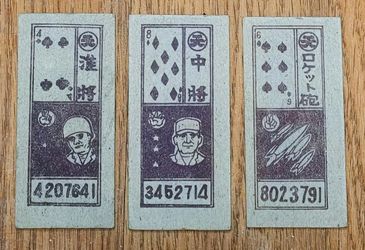
A final fact to add to this discussion. Not all the backs of this Batman Menko are the same. In other words, they all don't have General Douglas MacArthur on them (pics below). Some of them have other 1,2,3 or 4 Star US Generals on them. Others have US military themes like missiles & weaponry. The reason the "MacArthur" Batman Menko is the most desirable is by MacArthur being present on the Menko makes dating it based on Historical fact much easier. Plus, even during post war time in Japan in the 1940's, MacArthur would have been the more desirable Menko since he was viewed by many Japanese as a Liberator for their country as the Supreme Commander of the Allied Powers.
When I started this journey for Batman’s earliest card, the industry said Batman’s rookie card was the 1966 Topps. I found it surprising there was a 30 year gap between his first appearance on the 1936 Wolverine Card & the 1966 Topps. This 30 year gap is by far the longest of any superhero from when they first appeared to when their rookie card was produced. We now know, this 30 year gap from Batman's first appearance to his Rookie card simply isn't true!
When we look at this particular Batman Menko up close…..it tells an Amazing story. After putting all the pieces of this puzzle together, I’d like to announce to the Non-Sports Card Industry…...Batman has cards from the 1940’s!!